


Who Is Qualified to Install a Domestic Oil Tank?
Who Is Qualified to Install a Domestic Oil Tank?
A domestic oil tank should be installed by someone who is demonstrably competent in oil-storage tanks and fuel-supply systems. For most homeowners, the simplest option is an OFTEC-registered technician whose current registration specifically covers oil storage tank and supply-pipework installation.
OFTEC registration is not, however, the only possible route to a compliant installation in every part of the UK. In England and Wales, work may also be completed under another relevant Competent Person Scheme or approved through Building Control. Scotland and Northern Ireland have their own building standards and control arrangements.
The crucial point is that the installer must be competent for the work, follow the rules applying in your country and provide the appropriate certification or approval.
Does an oil tank have to be installed by an OFTEC engineer?
An oil tank does not necessarily have to be installed by an OFTEC-registered technician in every UK jurisdiction or circumstance. Nevertheless, choosing an appropriately registered OFTEC technician is usually the most straightforward way to demonstrate competence and manage compliance.
In England, the official government guidance on domestic oil storage recommends choosing someone registered with a Competent Person Scheme. A registered person can self-certify qualifying work and handle the Building Control notification.
If you use someone who is not registered with a suitable scheme, you will normally need to notify your local authority, arrange an inspection and pay the relevant Building Control charges yourself.
The Planning Portal’s guidance on fuel tanks and Building Regulations similarly states that employing an installer registered with a related Competent Person Scheme removes the need to involve a Building Control Service directly. This particular Planning Portal guidance relates to England.
OFTEC is the best-known scheme in the domestic oil-heating sector, but the installer’s scope of registration matters more than simply seeing an OFTEC logo.
What is an OFTEC-registered technician?
OFTEC operates a Competent Person Scheme for technicians working with liquid-fuel heating, oil storage, solid fuel and certain renewable technologies.
Registration indicates that a technician or business has met the scheme’s requirements for the work covered by its registration. However, OFTEC registrations have different scopes. Someone registered to service oil boilers is not automatically registered to install a new oil tank.
For tank work, look for a technician whose current registration covers:
- Oil storage tank installation
- Oil supply pipework
- The associated fittings and fire-safety controls
- The type and scale of work required at your property
The relevant OFTEC assessment commonly associated with domestic storage and supply systems is OFT10-600a. Its scope includes tank location, base suitability, bunding, fire protection, pipework, fittings and regional requirements. Reassessment is required after five years. oftec.org
Before accepting a quotation, use OFTEC’s register to check both the technician and the business. Ask to see the technician’s current identification card and confirm that the work categories shown include oil storage tank and supply-pipework installation.
Can a plumber install a domestic oil tank?
A plumber can install a domestic oil tank only if they have the necessary competence for oil-storage and supply work and the installation follows the applicable approval process.
General plumbing experience alone does not demonstrate competence in:
- Oil-pollution risk assessment
- Tank siting and fire separation
- Secondary containment
- Supporting-base requirements
- Oil supply pipework
- Fire-valve selection and positioning
- Building Regulations notification and certification
If a plumber is registered with OFTEC or another applicable scheme, check the exact scope of their registration. Do not assume that boiler, plumbing or heating qualifications automatically cover tank installation.
Can you install an oil tank yourself?
DIY installation is not a sensible route for most homeowners. A domestic oil tank is part of a fuel-storage and supply system, so mistakes can create a risk of fire, oil leakage, ground contamination and costly remedial work.
In England, a new or replacement domestic oil tank must meet Building Regulations. If the installer cannot self-certify through an applicable Competent Person Scheme, you will need to arrange the required Building Control process yourself. GOV.UK
A DIY installation would still need to satisfy requirements concerning matters such as:
- The strength, stability and dimensions of the base
- Separation from buildings, openings, boundaries and sources of ignition
- Fire-resistant barriers where required
- Pollution risk and secondary containment
- Safe tank access for inspection and fuel delivery
- Correctly installed supply pipework
- A suitable remote fire valve
- Manufacturer installation instructions
- Regional building requirements
The cost saved on labour may be outweighed by Building Control fees, alterations, oil leaks, rejected fuel deliveries, warranty problems or complications when selling the property.
What should a qualified oil tank installer assess?
A competent installer should inspect the property before confirming that a particular tank or location is suitable. Replacing an old tank is not always a like-for-like job because the original position may not meet current requirements.
Tank size and household demand
The installer should consider the property’s typical oil consumption, delivery pattern and available space. The aim is to select adequate capacity without creating unnecessary siting or access difficulties.
Domestic installations are commonly no more than 3,500 litres. In England, containers holding 3,501 litres or more fall under the rules for business oil storage rather than the standard domestic guidance. GOV.UK
The proposed location
The installer should examine the distance between the tank and:
- The house and any nearby buildings
- Doors, windows and other openings
- Boiler flues and other potential ignition sources
- Property boundaries
- Timber sheds, fences, decking and vegetation
- Drains, watercourses, wells and areas liable to flooding
- Overhead cables and underground services
These factors help determine whether the proposed position is acceptable and whether additional fire protection or secondary containment is required.
The supporting base
A filled tank can weigh several tonnes. Its base must therefore be level, stable, non-combustible and capable of supporting the tank throughout its service life.
The correct dimensions and construction depend on the tank, site and regional requirements. A qualified installer should check the manufacturer’s instructions and the applicable building guidance rather than relying on the dimensions of an old base.
Pollution and bunding risk
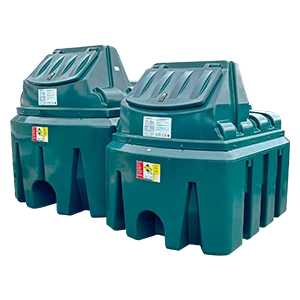
A bund provides secondary containment around the inner storage tank. An integrally bunded tank combines the inner tank and protective outer containment in one manufactured unit.
The installer should conduct a pollution-risk assessment to determine whether secondary containment is required. Factors can include proximity to drains or water, hard surfaces that could carry escaping oil, the tank’s capacity and the consequences of a leak.
A single-skin tank may be permissible in some lower-risk domestic situations, but it should not be selected until the site has been assessed. For many households, a bunded tank provides a more broadly suitable storage solution.
Fire protection
The installation must limit the chance of a fire reaching the stored oil. Required precautions can depend on the tank’s distance from buildings, openings, boundaries and combustible structures.
If standard separation distances cannot be achieved, an installer may consider an appropriate fire-resistant barrier or a purpose-made fire-protected tank. The solution must be designed for the individual site rather than improvised after delivery.
Supply pipework and fire valve
The job is not complete when the tank is placed on its base. The supply line must be correctly routed, protected and connected.
Where new connecting pipework is installed in England, the Planning Portal states that a fire valve is needed where the pipe enters the building. A competent installer should also select and position the valve correctly for the appliance and system. Planning Portal
Delivery access and ongoing inspection
The tanker driver must be able to deliver oil safely, and the householder or technician must be able to inspect the tank, fittings and pipework.
A tank squeezed tightly between walls or hidden behind permanent structures may be difficult to fill, check or replace. The installer should consider the entire working life of the tank, not just whether it physically fits on installation day.
Do the rules differ across the UK?
Yes. Building requirements, approval procedures and environmental rules are not identical throughout England, Wales, Scotland and Northern Ireland.
England
New and replacement domestic oil storage containers must comply with Building Regulations. Using a suitably registered Competent Person allows eligible work to be self-certified. Otherwise, the homeowner must involve Building Control.
Approved Document J contains guidance relevant to combustion appliances and fuel-storage systems. Planning permission is a separate issue and may be required in certain circumstances, such as some listed properties or prominent locations.
Wales
Wales has its own Building Regulations guidance. A technician registered with a relevant Competent Person Scheme can normally notify the local authority and provide a compliance certificate for the specific work covered by their registration. Welsh Government guidance lists several schemes for oil-related work, including OFTEC. GOV.WALES
Scotland
Scotland uses the Scottish Building Standards system rather than the Building Regulations framework used in England and Wales.
Its domestic technical guidance contains specific provisions for fuel storage, fire protection, bases and secondary containment. For example, the guidance addresses fixed oil tanks over 90 litres and specifies protective measures according to their distance from buildings and boundaries. Domestic
Check with the local authority building standards service before work begins to establish whether a building warrant or another approval is needed for the planned installation.
Northern Ireland
Northern Ireland has its own Building Regulations and local council Building Control system. NI Direct advises householders to use an OFTEC-registered technician and to check the technician’s ID card and registered work categories before work starts. nidirect
Because requirements and approval routes can change, confirm the current position with the relevant local authority whenever there is uncertainty.
What paperwork should you receive after installation?
Ask the installer to explain, in writing, which approval and certification route will be used before you accept the quotation.
Depending on the work and location, the completed installation may generate:
- A Building Regulations compliance certificate
- A commissioning or installation certificate
- A Building Control completion or approval document
- The tank manufacturer’s warranty information
- Product and serial-number details
- Installation and maintenance instructions
- A record of any risk assessment
- Paperwork covering transferred oil or removal of the old tank
Keep these documents with your property records. They may be relevant to future servicing, warranty claims, insurance queries or a house sale.
Do not make the final payment based solely on a promise that the paperwork will follow. Confirm what should be supplied and when.
How can you check an oil tank installer before hiring them?
A few checks can reveal whether an installer is suitably prepared for the job.
- Check the registration independently. Search the scheme’s official register rather than relying only on a logo displayed on a website or van.
- Confirm the work scope. Ask whether the individual is registered for oil tanks and oil supply pipework, not just appliance servicing.
- Check the business as well as the technician. Establish which business will contract with you, notify the work and stand behind the installation.
- Ask who handles Building Control. The quotation should make clear whether the installer will self-certify or whether a separate application is needed.
- Request a site survey. A reliable installer should not guarantee that a tank or position is compliant without gathering adequate information about the property.
- Ask what paperwork you will receive. Get the answer before work begins.
- Check insurance and warranties. Ask for evidence of appropriate public liability insurance and clarify what is covered by the workmanship and product warranties.
- Obtain a detailed written quotation. It should identify the tank, base work, pipework, valves, oil transfer, old-tank removal, certification and any fire-protection work.
Should you buy the tank before arranging a site survey?
Ideally, obtain professional installation advice before ordering. A site survey may show that the tank needs to be bunded, fire protected, made from a particular material or shaped to fit a restricted access route.
Useful details to gather include:
- The dimensions and capacity of the existing tank
- Photographs of the tank, base and surrounding area
- The approximate amount of oil remaining
- The distance to buildings, openings and boundaries
- Access widths from the road to the installation area
- The location of drains and nearby water
- Your postcode and country within the UK
Once the site requirements are understood, you can compare suitable domestic oil tanks for sale by capacity, dimensions, construction and containment type.
The tank itself must be suitable, but buying a compliant product does not automatically make the finished installation compliant. The location, base, pipework and protective measures are equally important.
Common mistakes to avoid
Choosing an installer based only on price
A low quotation may omit base construction, oil transfer, old-tank disposal, pipework replacement, fire protection or certification. Compare the scope of work, not just the total.
Assuming every OFTEC technician can install tanks
OFTEC registration covers different work categories. Verify that the technician’s registration includes oil storage tank and supply-pipework installation.
Ordering a single-skin tank before the risk assessment
The site may require secondary containment. If so, a single-skin tank could be unsuitable even if it fits the available space.
Reusing the existing location without checking it
A replacement installation normally needs to satisfy the requirements applying when the new tank is fitted. The fact that the previous tank occupied a particular position does not prove that the position is suitable now.
Confusing planning permission with Building Regulations
These are separate systems. A project may not need planning permission but may still have to comply with Building Regulations or regional building standards.
Frequently asked questions
Is OFTEC registration a legal requirement for an oil tank installer?
Not universally. In England and Wales, a suitably registered Competent Person can self-certify qualifying work. A non-registered route may be possible through Building Control, but the installation must still comply. Scotland and Northern Ireland use different regional systems.
How do I know if an OFTEC engineer can install oil tanks?
Check the official OFTEC register and the technician’s identification card. Their current scope should include oil storage tank and oil supply-pipework installation. Boiler-servicing registration alone is not sufficient evidence.
Do I need a certificate for a replacement oil tank?
You should receive the documents appropriate to the approval route, which may include a Building Regulations compliance certificate, Building Control documentation and an installation or commissioning record. Confirm the exact paperwork with the installer before work begins.
Can my new tank go in the same place as the old one?
Not automatically. The installer must reassess the location against current fire, pollution, access, base and regional requirements. Additional protection or a different location may be necessary.
Who is responsible for Building Control notification?
A technician registered under an applicable Competent Person Scheme can normally notify qualifying work through the scheme. If you use someone who cannot self-certify, responsibility for arranging Building Control approval may fall to you.
Does a bunded tank still require professional installation?
Yes. A bund reduces the risk of escaping oil, but it does not address every installation requirement. The base, siting, fire protection, fittings, supply pipework and certification must still be correct.
Choosing the right installer and tank
The person installing a domestic oil tank should be competent specifically in oil-storage and fuel-supply work. An OFTEC-registered technician with the correct tank-installation scope is usually the clearest option, but homeowners should still verify the registration, approval process and documentation before committing.
Arrange a site assessment before selecting the tank wherever possible. This reduces the risk of buying a product that is the wrong size, containment type or specification for the property.
Oil Tank Supermarket supplies a range of plastic, steel, bunded, single-skin and fire-protected tanks for different domestic requirements. You can explore Oil Tank Supermarket’s heating-oil storage range and then confirm the most appropriate model against your installer’s site assessment.

Share This: