

Types of Oil Tanks Explained: Which Oil Tank Do You Need?
Contents
- Types of Oil Tanks Explained: Bunded, Single Skin, Steel and Fire-Protected
- Oil tank types at a glance
- What is a bunded oil tank?
- What is a single skin oil tank?
- Bunded vs single skin oil tanks: what is the difference?
- What is a steel oil tank?
- What is a fire-protected oil tank?
- Is a steel tank the same as a bunded tank?
- Which type of oil tank do I need?
- UK oil tank installation and regulations
- Find the right oil tank for your property
- Frequently asked questions
Types of Oil Tanks Explained: Bunded, Single Skin, Steel and Fire-Protected
Choosing an oil tank is not simply a matter of finding the right capacity. You also need to consider how the tank is constructed, what material it is made from, where it will be installed and what level of protection the location requires.
The four main categories you are likely to encounter are:
- Bunded oil tanks
- Single skin oil tanks
- Steel oil tanks
- Fire-protected oil tanks
These categories can overlap. For example, a steel oil tank may be either single skin or bunded, while a fire-protected tank may be manufactured from plastic or steel. Understanding these distinctions will make it easier to compare products and choose a suitable tank for your property.
This guide explains the different types of oil tanks, their main advantages and the key differences you should consider before buying.
Oil tank types at a glance
| Oil tank type | Construction | Main advantage | Often suited to |
|---|---|---|---|
| Bunded oil tank | Inner storage tank and outer containment layer | Greater protection against leaks and spills | Most domestic, commercial and higher-risk installations |
| Single skin oil tank | One main storage layer | Lower initial purchase cost | Certain smaller, low-risk domestic installations |
| Steel oil tank | Manufactured from fabricated steel | Strength, durability and flexible sizing | Domestic, agricultural and commercial locations |
| Fire-protected oil tank | Tank with an integrated, tested fire-protection system | Helps overcome certain fire-separation challenges | Restricted sites or locations close to buildings and boundaries |
The right option will depend on a site-specific risk assessment and the regulations applying to your property and location.
What is a bunded oil tank?
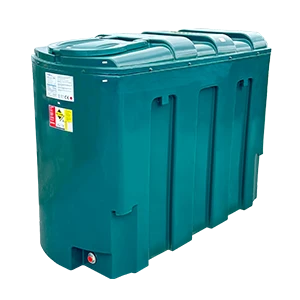
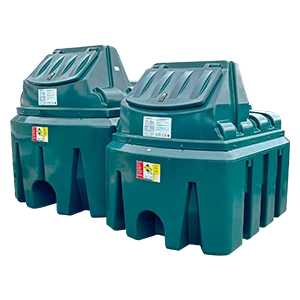
A bunded oil tank has two protective layers. The inner tank stores the heating oil, while the outer layer, known as the bund, is designed to contain oil if the inner tank develops a leak.
This “tank within a tank” construction provides significantly more protection than a standard single skin tank. It reduces the chance of oil escaping into nearby soil, drains or watercourses.
The principal benefits of a bunded heating oil tank include:
- Built-in secondary containment
- Greater protection against leaks and spills
- Reduced risk of environmental contamination
- Suitability for a wider range of properties
- Availability in plastic and steel designs
- Greater peace of mind when storing large volumes of heating oil
The outer containment area of an integrally bunded tank is normally designed to hold at least 110% of the inner tank’s maximum capacity. If the inner tank leaks, the oil should therefore remain contained within the external bund.
Bunded tanks generally cost more than equivalent single skin models. However, the additional cost reflects their double-layer construction and the greater protection they provide.
For a closer comparison, read this guide to bunded vs single skin oil tanks.
What is a single skin oil tank?
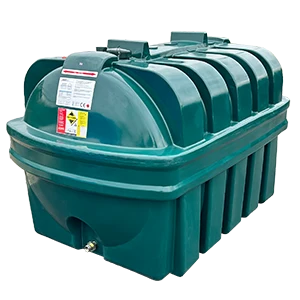
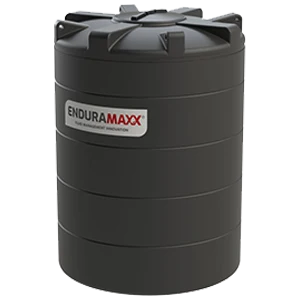
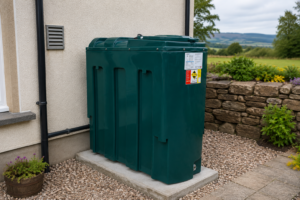
A single skin oil tank consists of one main container that directly holds the oil. It does not have a built-in outer bund to capture fuel if the tank leaks.
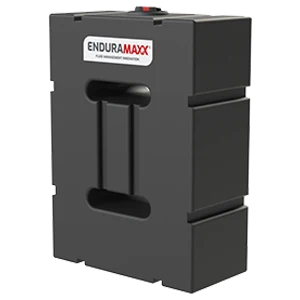
Because less material is required during manufacturing, single skin tanks are generally lighter and less expensive than bunded alternatives. They are available in several capacities and shapes, including compact and slimline designs for properties with limited access.
Single skin oil tanks may offer:
- A lower upfront purchase price
- A lightweight construction
- Straightforward handling and positioning
- A choice of capacities and footprints
- A practical option for certain low-risk sites
The important difference is that a single skin tank does not provide secondary containment. If the tank or one of its connections fails, oil may escape directly into the surrounding area.
This does not mean that single skin tanks are unsuitable in every situation. They may still be used at some smaller domestic installations where a competent person’s risk assessment confirms that bunding is not required.
The tank’s capacity, proximity to drains or water, ground conditions and intended use must all be considered. Tuffa provides further guidance on choosing between a single skin and bunded oil tank.
Bunded vs single skin oil tanks: what is the difference?
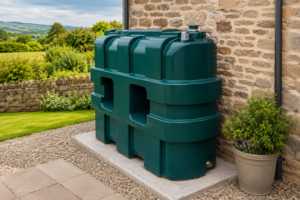
The main difference between bunded and single skin oil tanks is secondary containment.
A single skin tank has one layer holding the oil. A bunded tank has an inner storage tank surrounded by an outer containment layer.
Protection against leaks
A bunded tank is designed to contain oil if its inner tank fails. A single skin model does not have this second protective barrier.
Purchase price
Single skin tanks normally cost less initially. Bunded tanks use more material and have a more complex construction, resulting in a higher purchase price.
Installation suitability
Bunded tanks can be used in a wider range of locations, particularly where a leak could reach a drain, watercourse, borehole or environmentally sensitive area.
Single skin models are usually limited to lower-risk installations where their use is permitted following an assessment.
Size and weight
A bunded tank is generally larger and heavier than a single skin tank with the same usable capacity because of its outer containment shell.
Long-term risk
Although a single skin tank can reduce the upfront cost, a leak could lead to lost heating oil, property damage and expensive environmental clean-up work. The additional protection of a bunded model can therefore offer better long-term reassurance.
For most new domestic installations, a bunded oil tank is the more protective and versatile choice. However, an installer should assess the property before recommending a particular tank.
What is a steel oil tank?
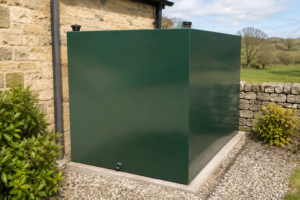
A steel oil tank is manufactured from fabricated steel rather than rotationally moulded plastic. Steel describes the tank’s material, not its containment type.
This means a steel oil tank can be:
- Single skin
- Double skin
- Fully bunded
- Fire protected
- Manufactured to a standard or bespoke capacity
Steel tanks are valued for their strength and rigidity. They can be particularly useful for commercial, agricultural or industrial properties and for installations requiring a less common shape or capacity.
Advantages of steel oil tanks
Steel heating oil tanks can provide:
- Strong and rigid construction
- Good resistance to accidental impact
- A wide choice of capacities
- Bespoke manufacturing possibilities
- Single skin and bunded options
- Fire-protected configurations
What should you consider?
Steel must be properly protected against corrosion. The external coating, installation conditions and ongoing maintenance are therefore important.
A steel tank should be inspected regularly for signs of rust, coating damage, water accumulation or deterioration around its fittings and supports.
Plastic tanks do not rust and are often lighter, making them popular for ordinary domestic installations. Steel tanks, however, can offer greater strength and more flexibility for demanding or unusual storage requirements.
Neither material is automatically better in every situation. The choice between a plastic and steel oil tank should be based on the installation environment, required capacity, access, maintenance needs and overall budget.
What is a fire-protected oil tank?
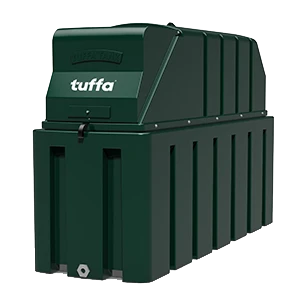
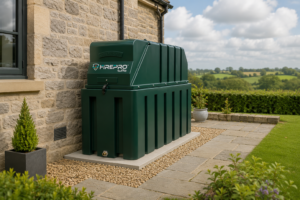
A fire-protected oil tank, also known as a fire-rated oil tank, incorporates a tested fire-protection system around the fuel storage tank.
Depending on the model and certification, the fire-resistant construction may offer 30 or 60 minutes of protection. These tanks are intended to prevent the stored fuel from igniting for the specified period when exposed to fire.
Fire-protected tanks are especially useful where standard separation distances are difficult to achieve. This could include installations close to:
- A house or other building
- A property boundary
- Doors or windows
- Eaves
- Combustible structures
Without an appropriate fire-protected tank, some locations may require a separately constructed fire barrier. An integrally fire-protected model can provide a more compact alternative, subject to the product’s certification and approval for the proposed installation.
Fire-protected oil tanks may be made from plastic or steel and are frequently bunded. “Fire protected” therefore describes the tank’s resistance to external fire rather than the material or number of storage layers.
A fire-rated tank does not automatically make every location acceptable. Separation distances, building regulations, manufacturer requirements and the tank’s certification must still be checked by a competent installer or building control professional.
Is a steel tank the same as a bunded tank?
No. “Steel” describes what the oil tank is made from, while “bunded” describes its containment design.
A steel oil tank can be single skin or bunded. In the same way, a plastic oil tank can also be single skin or bunded.
The classifications can be understood as three separate questions:
- Containment: Is the tank single skin or bunded?
- Material: Is it made from plastic or steel?
- Fire protection: Does it have an integrated, certified fire-protection system?
For example, one product could be described as a steel bunded fire-protected oil tank because it combines all three characteristics.
Which type of oil tank do I need?
For many homeowners, a plastic bunded oil tank provides a practical combination of secondary containment, weather resistance and a broad selection of sizes.
A different type may be more appropriate if:
- You need a lower-cost tank for an assessed low-risk site
- The tank could be exposed to accidental impact
- You require a bespoke size or shape
- The proposed location has restricted fire-separation distances
- You are storing oil at a commercial or agricultural property
- The tank is close to drains, water or environmentally sensitive land
As a simple starting point:
- Choose a bunded tank when enhanced leak protection is the priority.
- Consider a single skin tank only when an assessment confirms it is suitable and permitted.
- Consider a steel tank when strength, rigidity or bespoke sizing is important.
- Consider a fire-protected tank when the intended position presents fire-separation difficulties.
Do not order a replacement based solely on the type of tank already installed. Requirements and site conditions may have changed since the original installation.
UK oil tank installation and regulations
Oil storage requirements vary according to tank capacity, property type, location and which part of the UK the installation is in. Domestic, commercial and agricultural installations can be subject to different rules.
Factors considered during an oil tank risk assessment can include:
- Tank capacity
- Distance from buildings and boundaries
- Proximity to drains, rivers, wells and boreholes
- Whether a spill could reach controlled water
- The condition and material of the tank base
- Visibility between the fill point and vent
- Fire-separation distances
- Risk of impact or accidental damage
The safest approach is to have the site assessed by a suitably qualified competent person before purchasing or positioning a tank. The tank must also be installed on an appropriate base and in line with the manufacturer’s instructions.
Find the right oil tank for your property
The best oil tank is one that combines suitable capacity, safe containment and compatibility with its proposed location.
Bunded tanks provide greater protection against leaks, while single skin tanks may suit some carefully assessed low-risk sites. Steel tanks offer strength and flexible manufacturing options, and fire-protected tanks can help with challenging locations where normal separation distances cannot easily be achieved.
At Oil Tank Supermarket, you can explore bunded, single skin, steel and fire-protected oil tanks in a range of capacities and designs. If you are unsure which model is suitable, obtain professional installation advice and a site assessment before ordering.
Frequently asked questions
What is the safest type of domestic oil tank?
A bunded oil tank will generally provide greater protection than a single skin model because its outer layer can contain oil leaking from the inner tank. The safest choice still depends on correct tank selection, positioning and installation.
Are all bunded oil tanks made from plastic?
No. Bunded oil tanks are available in both plastic and steel. “Bunded” refers to the double-layer containment design rather than the material.
Can I still install a single skin oil tank?
A single skin tank may be acceptable at certain low-risk domestic installations, but this must be confirmed through an appropriate site assessment. Bunded tanks are required or strongly preferred in many higher-risk situations.
Are steel oil tanks better than plastic tanks?
Steel tanks offer excellent strength and can be manufactured in bespoke sizes. Plastic tanks do not rust and are usually lighter. The better choice depends on the site, capacity, access, maintenance requirements and risk of impact.
What is the difference between a fire-rated and bunded oil tank?
A bunded tank is designed to contain leaks. A fire-rated tank is designed to resist external fire for a certified period. A tank can be both bunded and fire protected.
Do I need a fire-protected oil tank?
You may need a fire-protected tank or another approved fire barrier if the tank cannot meet the required separation distances from buildings, boundaries or combustible structures. A qualified installer or building control professional should assess the proposed location.

Share This: