
Single Skin vs Bunded Oil Tanks: What’s the Difference and Which Is Best?
Single Skin vs Bunded Oil Tanks: What’s the Difference and Which Is Best?
Choosing between a bunded oil tank and a single skin oil tank is one of the most important decisions you can make when replacing or upgrading your domestic heating oil storage.
At first glance, the difference can seem simple. A single skin tank has one layer, while a bunded tank has built-in secondary containment. But when you look closer, the choice affects more than just the purchase price. It can also influence environmental protection, installation suitability, long-term peace of mind, insurance considerations and compliance with UK oil storage guidance.
For most UK homeowners, a bunded oil tank is the safer and more regulation-friendly choice. That said, single skin oil tanks can still be suitable in certain lower-risk domestic situations, provided the tank location, capacity and installation meet the required standards.
In this guide, we explain the difference between bunded and single skin oil tanks, when each type may be suitable, and which option is best for your property.
What is a bunded oil tank?
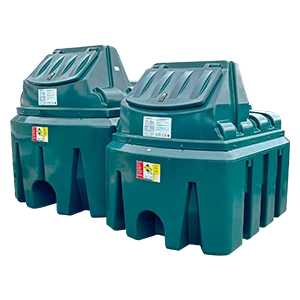
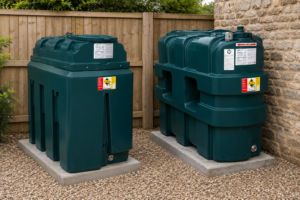
A bunded oil tank is a heating oil tank with built-in secondary containment. In simple terms, it is often described as a tank within a tank.
The inner tank holds the heating oil, while the outer tank is designed to contain leaks or spillages if the inner tank fails. This extra layer of protection is the main reason bunded tanks are widely recommended for domestic heating oil storage.
Bunded tanks are also commonly called double skinned oil tanks, although “bunded” is the more useful term when talking about oil storage protection.
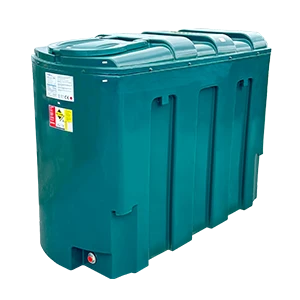
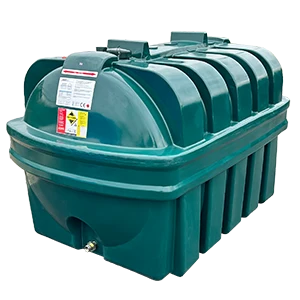
If you are comparing replacement oil tanks for your home, you can view our full range of bunded oil tanks, including popular plastic bunded tanks in a range of domestic capacities.
What is a single skin oil tank?
A single skin oil tank is a heating oil tank with one main layer of containment. It does not include the built-in secondary containment found in a bunded tank.
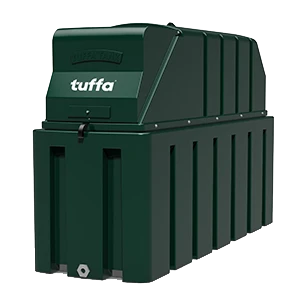
Single skin tanks are usually cheaper to buy, lighter to handle and easier to position in some restricted areas. This can make them appealing for homeowners who want a cost-effective replacement tank.
However, because a single skin tank does not have an outer containment layer, it offers less protection if the tank cracks, splits or leaks. This means single skin oil tanks are only suitable where the site has been properly assessed and bunding is not required.
You can browse our range of single skinned oil tanks if your property has been assessed as suitable for this type of tank.
Bunded vs single skin oil tanks: quick comparison
| Feature | Bunded oil tank | Single skin oil tank |
|---|---|---|
| Structure | Inner tank plus outer containment layer | One main storage layer |
| Leak protection | Higher, due to secondary containment | Lower, as there is no built-in bund |
| Upfront cost | Usually higher | Usually lower |
| Best for | Most domestic replacements, higher-risk sites, larger tanks | Lower-risk domestic sites where bunding is not required |
| Regulation friendliness | More likely to meet a wider range of site requirements | More restricted and dependent on location |
| Environmental protection | Stronger protection against leaks and spills | Less protection if the tank fails |
| Long-term value | Often better due to added safety and reduced risk | Lower upfront cost, but less protection |
| Peace of mind | Higher | Depends heavily on site suitability |
Are bunded oil tanks compulsory in the UK?
Bunded oil tanks are not compulsory for every domestic property in every situation. However, they are required in many common circumstances, especially where there is a higher risk of pollution.
In England, a new or replacement domestic oil tank installation should be assessed by a competent installer. They will look at the tank size, position and surrounding area to decide whether secondary containment is required.
A bunded tank may be required if:
-The tank can hold more than 2,500 litres of oil
-Oil could run into an open drain or loose manhole cover
-The tank is within 10 metres of inland fresh water or coastal water
-The tank is within 50 metres of a drinking water source, such as a well, spring or borehole
-Oil could run across hard ground and reach water
-The vent pipe cannot be seen clearly during filling
-The tank is in a sensitive groundwater protection area
-The property or installation type creates a higher pollution risk
Rules can vary across England, Wales, Scotland and Northern Ireland, so it is always worth checking the requirements for your location before ordering a tank.
For more detail on when bunding may be needed, Certas Energy has a useful guide explaining what a bunded oil tank is and whether it may be compulsory for your home.
When is a single skin oil tank suitable?
A single skin oil tank may still be suitable for some domestic properties, but only when the site is considered low risk.
In general, a single skin tank is more likely to be suitable when:
-The tank capacity is below the threshold where bunding is required
-The tank is not close to streams, rivers, ponds, drains or wells
-Oil could not easily run into a water source if a leak occurred
-The tank is installed on a stable, suitable base
-The surrounding area does not create a high pollution risk
-A competent installer has confirmed that secondary containment is not required
This is the key point: single skin tanks should not be chosen simply because they are cheaper. They should only be chosen when the property and installation location are genuinely suitable.
For homeowners with a simple, low-risk installation area, a single skin oil tank can still be a practical and cost-effective option. For everyone else, a bunded tank is usually the better long-term choice.
Why bunded oil tanks are usually the better choice
Although bunded oil tanks usually cost more upfront, they offer several advantages that can make them better value over time.
1. Better protection against leaks
The biggest benefit of a bunded oil tank is the extra containment layer. If the inner tank develops a fault, the outer bund is designed to help contain the oil.
This matters because heating oil leaks can be expensive, stressful and damaging. A spill can affect soil, drains, groundwater, gardens, driveways and nearby watercourses. In some cases, clean-up costs can be far higher than the original price difference between a single skin and bunded tank.
2. More suitable for modern oil tank regulations
Bunded tanks are generally more regulation-friendly because they are designed with secondary containment built in.
Even where a bunded tank is not legally required, many homeowners choose one because it offers more flexibility. If your property has a drain nearby, a watercourse close by or limited space for positioning, a bunded tank may help avoid problems that would make a single skin tank unsuitable.
3. Better long-term peace of mind
A heating oil tank is not something most homeowners want to replace regularly. Once it is installed, you want confidence that it is suitable, safe and ready for years of use.
A bunded oil tank gives added reassurance because it provides another layer of protection between the stored oil and the surrounding environment.
4. A safer choice for larger oil storage
If you store larger quantities of heating oil, the risk of a leak becomes more serious. More oil means greater potential damage if something goes wrong.
For larger domestic tanks, bunded oil tanks are often the sensible choice and may be required depending on the capacity and location.
5. Stronger environmental protection
Oil storage is not just about keeping your heating system running. It is also about protecting your property and the environment around it.
A bunded tank helps reduce the risk of oil escaping into soil, drains or water. This is particularly important for rural homes, properties near water, farms, large gardens and homes with older drainage systems.
Why do some people still choose single skin oil tanks?
Single skin oil tanks still have a place in the market because they can work well in the right situation.
The main advantages are:
-Lower upfront cost
-Lighter and easier to move into position
-Slimline options for restricted spaces
-Simple design
-Useful for suitable low-risk domestic installations
For some homeowners, especially those replacing a smaller tank in a low-risk area, a single skin tank may be enough. The important thing is to get the site assessed properly before making that decision.
Cost comparison: is a bunded oil tank worth the extra money?
In most cases, yes, a bunded oil tank is worth the extra money if you want the safest and most future-proof option.
A single skin tank may save money upfront, but it gives you less protection if something goes wrong. A bunded tank costs more initially, but it can reduce risk, improve peace of mind and make it easier to meet installation requirements.
A good way to think about it is this:
-Choose a single skin tank if your site is low risk, your capacity is suitable and your installer confirms it is appropriate.
-Choose a bunded tank if you want stronger protection, easier compliance and a safer long-term investment.
For most homeowners replacing an old oil tank, the bunded option is the more sensible recommendation.
Which oil tank is best for your home?
For most UK homes, a bunded oil tank is the best choice. It offers better leak protection, stronger environmental safety and a more regulation-friendly installation.
A single skin oil tank may still be suitable if your property is low risk and the installation has been assessed correctly. However, if there is any doubt, a bunded tank is usually the safer option.
Choose a bunded oil tank if:
-You want the safest option
-Your tank is near drains, water or sensitive ground
-You are storing a larger amount of oil
-You want better long-term protection
-You want to reduce the risk of costly leaks
-You want a tank that is more likely to satisfy modern installation requirements
Choose a single skin oil tank if:
-Your site has been assessed as low risk
-You need a lower-cost replacement
-Space or access is restricted
-Your tank capacity and location do not require bunding
-A competent installer confirms it is suitable
Final verdict: bunded or single skin oil tank?
If you are deciding between a bunded and single skin oil tank, the safest answer is this: choose a bunded oil tank unless you have a clear reason not to.
Single skin tanks can still be useful in the right setting, but they are more limited. They rely heavily on the tank location being suitable and the surrounding area being low risk.
Bunded tanks offer more protection, better peace of mind and a stronger long-term solution for domestic heating oil storage. That is why they are usually the better choice for homeowners replacing an old tank or installing a new one.
At Oil Tank Supermarket, we supply a wide range of domestic oil tanks to suit different homes, capacities and installation requirements. Whether you need a compact single skin tank or a safer bunded replacement, choosing the right tank now can help protect your home, your heating supply and the environment around you.
Frequently asked questions
What is the main difference between a bunded and single skin oil tank?
The main difference is secondary containment. A bunded oil tank has an inner tank and an outer containment layer, while a single skin oil tank has one main layer. This means a bunded tank offers better protection if a leak or spill occurs.
Is a bunded oil tank better than a single skin tank?
For most homes, yes. A bunded oil tank is usually better because it provides extra protection, is more suitable for higher-risk sites and is more regulation-friendly. A single skin tank may still be suitable for certain low-risk domestic installations.
Do I legally need a bunded oil tank?
Not always. Whether you need a bunded oil tank depends on your tank capacity, location and risk of pollution. Tanks over certain capacities or near drains, watercourses, wells or sensitive ground are more likely to require bunding. Always get the site checked before ordering.
Can I replace a single skin tank with another single skin tank?
Possibly, but only if the site is still suitable. If the tank location now requires secondary containment, you may need to upgrade to a bunded oil tank instead. A competent installer can confirm what is suitable for your property.
Are single skin oil tanks still allowed?
Single skin oil tanks can still be allowed in some domestic situations, but they are more restricted than bunded tanks. They should only be used where the installation is low risk and secondary containment is not required.
Are bunded oil tanks more expensive?
Yes, bunded oil tanks usually cost more upfront than single skin tanks. However, they offer better protection and can be better value in the long run because they reduce the risk of costly leaks, pollution issues and unsuitable installation problems.
What size oil tank do I need for my home?
The right size depends on your property size, heating usage, boiler efficiency and how often you want to order oil. Common domestic tank sizes include 650 litres, 1,000 litres, 1,200 litres, 1,350 litres and 2,400 litres.
Should I choose plastic or steel?
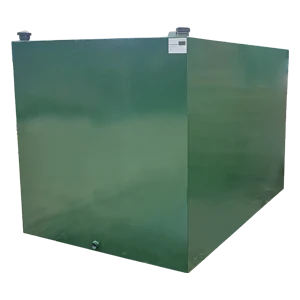
Both plastic and steel oil tanks can be suitable. Plastic tanks are popular for domestic properties because they are corrosion-resistant and widely available in slimline designs. Steel tanks can be useful where extra strength, custom sizing or fire protection is required.
What is the safest oil tank for domestic heating oil?
A bunded oil tank is usually the safest option for domestic heating oil because it includes built-in secondary containment. This helps protect your property and the surrounding environment if the inner tank leaks.

Share This: