

Can I Install an Oil Tank Myself in the UK? What You Need to Know
Can I Install an Oil Tank Myself in the UK? What You Need to Know
The direct answer is that a domestic oil tank should not be treated as a DIY installation project.
There is not one simple UK-wide rule stating that a homeowner can never physically carry out any part of an installation. However, installing or replacing an oil tank involves legal, environmental and safety requirements. The completed work must comply with the relevant regulations and may need to be inspected and formally approved.
In England, a new or replacement domestic oil storage tank must meet Building Regulations. When the work is completed by an installer registered under an approved competent person scheme, they can normally self-certify that the installation complies.
When a registered competent person is not used, the homeowner must contact local authority Building Control, arrange the required notice and pay for an inspection. Approval should be arranged before work begins rather than after the tank has been installed. Requirements differ in Wales, Scotland and Northern Ireland.
For most homeowners, the sensible approach is to use an appropriately qualified professional who can assess the site, select the correct tank, install the pipework and provide the necessary compliance documentation.
Can You Legally Install Your Own Oil Tank?
The more useful question is not simply whether you can move a tank into position. It is whether you can demonstrate that the complete installation complies with every applicable requirement.
An oil tank installation may involve:
- Choosing a legally suitable location
- Completing an environmental risk assessment
- Selecting the correct type and capacity of tank
- Constructing a suitable supporting base
- Maintaining fire-safety separation distances
- Installing compliant oil supply pipework
- Fitting isolation and fire-safety components
- Providing safe access for fuel deliveries
- Decommissioning the previous tank
- Notifying Building Control
- Obtaining an installation certificate
An error in any one of these areas could leave the installation unsafe or non-compliant.
GOV.UK advises homeowners to choose an installer registered with a competent person scheme. Such installers can self-certify their work and deal with Building Control requirements. Without this route, the homeowner is responsible for arranging approval and may have to pay for defective work to be corrected.
You can read more about OFTEC regulations and requirements for oil tanks before arranging your installation.
Is an OFTEC-Registered Installer Legally Required?
OFTEC registration is not the only possible route to a compliant installation.
Another installer registered under an appropriate competent person scheme may also be able to self-certify their work. Alternatively, work completed outside a competent person scheme will usually require involvement from local authority Building Control.
However, choosing an OFTEC-registered technician is often the simplest option for householders because the installer has been assessed for the relevant type of oil-heating work and can normally manage the compliance process.
Make sure the technician’s registration covers oil storage tanks and oil supply pipework, rather than assuming that any heating qualification covers every part of the job. OFTEC’s current technician search distinguishes between different installation and servicing categories.
A professional installation can also provide documentation that may be requested by:
- Building Control
- A future buyer or conveyancer
- Your home insurer
- A heating oil supplier
- A tank warranty provider
OFTEC warns that a missing compliance certificate can create complications when a property is sold.
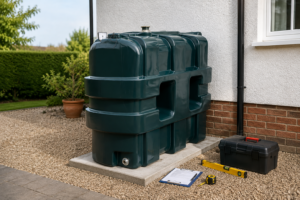
Why Is Domestic Oil Tank Installation So Complex?
A heating oil tank can contain hundreds or thousands of litres of fuel.
A poorly constructed base could allow the tank to move or deform. Incorrect pipework could leak. Unsuitable siting could increase the risk of a nearby fire reaching the stored oil, while a spill near a drain, stream or water source could cause extensive pollution.
This is why a domestic oil tank installation must be assessed as a complete system. The tank itself may meet the relevant manufacturing standards, but that does not automatically make the installation compliant.
The installer must also consider the property, surrounding structures, ground conditions, boiler location, delivery access and environmental risks.
1. Choosing a Suitable Location
Oil tank siting is one of the most important parts of the installation.
The most convenient-looking area of a garden may not be compliant. A tank cannot simply be placed next to a shed, fence, window, boiler flue or drain without assessing the relevant risks.
The installer will normally consider:
- Distance from buildings
- Distance from doors and windows
- Distance from boiler flue terminals
- Distance from property boundaries
- Nearby sheds and timber structures
- Trees, hedges and vegetation
- Drains and manhole covers
- Streams, ponds and other watercourses
- Wells, springs and boreholes
- Overhead cables
- Vehicle movements
- Flood risk
- Access for future inspection
- Access for the delivery tanker
OFTEC publishes specific separation guidance intended to protect stored fuel from a fire or nearby heat source. Where the normal separation distances cannot be achieved, a correctly designed fire-resistant barrier may be required. This is not something that should be improvised using an ordinary garden wall or fence.
Delivery Access Also Matters
The tanker driver must be able to reach the fill point safely.
When choosing the location, consider:
- Where the delivery tanker can park
- How far the delivery hose must travel
- Whether the driver can see the tank or vent
- Whether gates and paths are wide enough
- Whether the driver must cross steps or obstacles
- Whether the tank can be inspected from every side
A location that hides the tank completely behind fencing or vegetation may make safe delivery and routine inspection more difficult.
Oil Care recommends leaving sufficient room around the tank so that both the homeowner and delivery driver can inspect it and access the fill point safely.
2. Constructing the Correct Oil Tank Base
A domestic oil tank must be installed on a stable, level and properly constructed base.
The base has to support the weight of the tank when full. One litre of heating oil weighs less than one kilogram, but a large tank and its contents can still place a substantial load on the ground beneath it.
A base that sinks, cracks or moves can place uneven pressure on the tank. Plastic tanks are particularly dependent on continuous support across their base and should never be balanced on blocks, timber or loosely positioned paving.
Current Oil Care guidance states that the supporting base should be stable and level and extend at least 300mm beyond the widest part of the tank in every direction. It gives examples including a suitably constructed concrete slab or closely butted paving slabs installed on an appropriate foundation.
The exact construction will depend on:
- Tank capacity and dimensions
- Manufacturer instructions
- Ground conditions
- Drainage
- Whether the ground is sloping
- Whether the tank must be elevated
- Local Building Control requirements
Do not order a tank based solely on the dimensions of an existing base. The previous base may be too small, damaged or unsuitable for the replacement model.
An installer should assess the base before the tank is filled. A tank that appears stable while empty may behave very differently once it contains a full delivery of heating oil.
3. Installing the Oil Supply Pipework
The tank is only one part of the heating oil storage system.
Oil must travel safely from the tank to the boiler or other appliance. Pipework design can involve the correct materials, pipe diameter, joints, valves, filters, protection and routing.
Potential risks include:
- Leaking joints
- Pipework damaged by vehicles or garden tools
- Underground pipes that cannot be inspected
- Incorrectly supported pipes
- Pipes routed through unsuitable parts of the building
- Corrosion
- Damage caused by ground movement
- Failure to fit the required isolation or fire valve
- Old pipework being reused without assessment
Planning Portal guidance states that where new connecting oil pipework is installed, a fire valve is required where the pipe enters the building. The complete installation must also meet Building Regulations requirements.
A fire valve is designed to stop the oil supply when excessive heat is detected near the appliance. Its type and position must be suitable for the system.
This is one reason oil tank installation should not be divided into uncoordinated DIY tasks. The tank, pipework, fire valve and appliance need to be considered together.
Can Existing Pipework Be Reused?
Existing pipework should not automatically be reused just because it appears undamaged.
A professional should assess its:
- Age
- Material
- condition
- Route
- Jointing
- Protection
- Compatibility with the new tank
- Compliance with current requirements
Hidden or underground pipework may require additional investigation because a small leak can remain unnoticed while contaminating the surrounding ground.
Unused oil pipes should be properly decommissioned and capped or removed to prevent accidental filling and future leaks. Oil Care recommends professional removal of redundant tanks and pipework wherever practical.
4. Meeting Fire-Safety Requirements
Heating oil tanks need protection from external fires and heat sources.
The tank’s position in relation to the house, garage, shed, fence, windows, doors, boiler flue and surrounding vegetation must be considered.
A competent installer will determine whether the proposed location provides adequate separation. When it does not, a purpose-designed fire barrier or another compliant solution may be necessary.
Fire protection is not simply a matter of placing a few concrete blocks between the tank and a nearby shed. The barrier may need:
- A specified fire-resistance rating
- Appropriate dimensions
- Correct positioning
- A suitable distance from the tank
- A stable foundation
- Compliance with Building Regulations
- Approval from Building Control where applicable
OFTEC’s consumer guidance provides standard separation distances for common situations and explains that a fire-resistant barrier may be needed where those distances cannot be achieved.
The tank base also forms part of the fire-safety assessment. The required projection around the tank helps reduce the risk posed by nearby combustible materials and vegetation.
5. Protecting the Environment from Oil Spills
A heating oil leak can contaminate:
- Soil
- Surface water
- Groundwater
- Drains
- Streams and rivers
- Wells and boreholes
- Neighbouring properties
The installer must therefore complete an environmental risk assessment before selecting the tank and location.
In England, GOV.UK states that secondary containment, commonly called a bund, is required in certain higher-risk circumstances. These include locations where a spill could reach a drain or water source, situations where the tank vent cannot be seen during filling and tanks with a capacity greater than 2,500 litres. A compliant bund must hold 110% of the tank’s capacity and be impermeable to oil and water.
Different rules and environmental authorities apply across the UK, so the local requirements must be checked for the property.
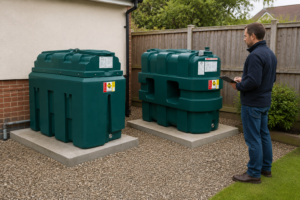
What Is a Bunded Oil Tank?
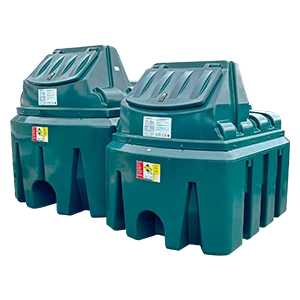
A bunded oil tank has an inner tank that holds the fuel and an outer containment layer designed to capture oil if the inner tank or associated components fail.
A bunded tank may be required by the risk assessment. Even when it is not strictly mandatory, it may still be selected to provide additional protection.
A single-skinned tank should never be chosen solely because it costs less. Whether it is appropriate depends on tank capacity, siting and environmental risk.
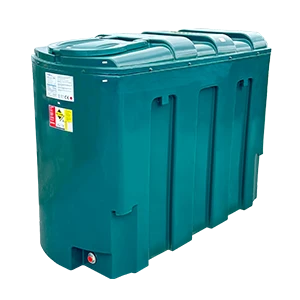
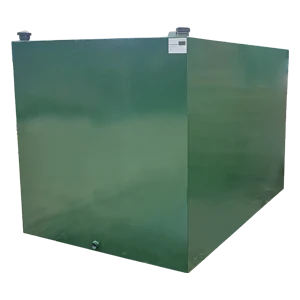
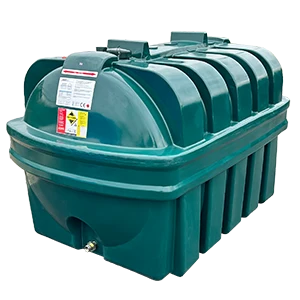
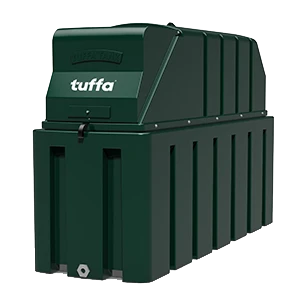
You can compare bunded, single-skinned, steel and fire-protected options in the Oil Tank Supermarket oil tank range. Final tank selection should be confirmed with the person responsible for the installation.
Do Oil Tank Rules Differ Across the UK?
Yes. There is no single set of identical domestic installation procedures covering every part of the UK.
GOV.UK’s main domestic storage page explains the requirements for homes in England and directs users to separate Building Regulations for Wales, Scotland and Northern Ireland.
This means advice found online should not automatically be applied to every property.
Before work begins, confirm:
- Which national regulations apply
- Whether Building Control must be notified
- Which environmental authority covers the location
- Whether local planning restrictions apply
- Whether the property is listed or in a protected area
- Whether the installer can self-certify in that nation
- What paperwork will be issued
A professional familiar with the relevant regional requirements can help prevent the installation being designed around guidance that does not apply to your property.
What Does a Professional Oil Tank Installation Include?
The precise service will depend on the property and installer, but a professional installation may include:
- A site survey – The installer inspects the proposed position, access, ground conditions, nearby structures and environmental risks.
- Tank specification – They recommend a suitable capacity, material and containment type based on the property’s requirements.
- Siting assessment – Distances from buildings, boundaries, openings, flues, drains and water sources are checked.
- Base assessment or construction – The base is designed or inspected to make sure it can support the full tank.
- Removal of the previous tank – Remaining fuel may need to be transferred safely before the old tank is decommissioned and removed.
- Positioning the new tank – The tank is moved into place without damaging its body, base or fittings.
- Pipework installation – Suitable valves, filters, fire-safety components and oil lines are fitted.
- Testing and commissioning – The tank, fittings and supply system are checked before use.
- Building Regulations notification – A registered competent person can normally self-certify qualifying work in the regions where the scheme applies.
- Handover documentation – The homeowner should receive appropriate installation, warranty and compliance documents.
Ask what is included before accepting a quotation. Tank delivery, base construction, fuel transfer, old tank removal and Building Control fees may be priced separately.
What Can a Homeowner Safely Do?
Homeowners can help prepare for an installation without attempting regulated or safety-critical work.
Useful preparation can include:
- Measuring the available area
- Photographing the proposed location
- Checking delivery access
- Clearing loose garden items
- Finding details of the existing tank
- Locating previous installation certificates
- Estimating the required capacity
- Obtaining several professional quotations
- Contacting the home insurer
- Discussing the project with Building Control where required
Do not:
- Transfer heating oil using unsuitable pumps or containers
- Cut into live oil pipework
- Move a tank that still contains fuel
- Reuse damaged fittings
- Build a base without an agreed specification
- Construct an improvised fire barrier
- Connect the tank to the boiler yourself
- Fill a newly installed tank before it has been approved
- Dispose of residual oil through drains or onto the ground
Any preparatory groundwork should be agreed with the installer first. This prevents a new base or enclosure being constructed only to be rejected during the site assessment.
Can You Put a New Tank in the Same Place as the Old One?
Not necessarily.
An older tank may have been installed under previous requirements, or the surroundings may have changed since installation.
For example:
- A shed may have been built nearby
- A fence may have been replaced
- New windows or doors may have been added
- Vegetation may have grown around the tank
- The base may have cracked or subsided
- A drain may have been installed
- Current environmental guidance may require a bunded tank
- The replacement tank may have different dimensions
The new installation should be assessed against current requirements. Do not assume that the previous location is automatically suitable simply because the old tank remained there for many years.
Can You Install a Second-Hand Oil Tank?
A second-hand tank can carry risks that are difficult for a homeowner to assess.
Moving a used tank may cause damage to:
- The tank body
- Seams
- Threads
- Fittings
- Seals
- Internal supports
- Protective coatings
Plastic tanks may also have suffered from sunlight exposure, distortion or cracking, while steel tanks may have hidden corrosion.
Oil Care advises having any second-hand tank inspected by a competent person before installation and warns against using tanks showing deformation, rust, whitening, cracks or splits.
Manufacturer warranties may not transfer to a new owner or may be invalidated by relocation. Check the warranty terms before purchasing a used tank.
What Happens If an Oil Tank Is Installed Incorrectly?
Consequences can include:
- Building Control enforcement
- The cost of correcting or relocating the installation
- A missing compliance certificate
- Problems during a house sale
- Invalidated tank warranties
- Difficulties with home insurance
- Refusal of a heating oil delivery
- Fuel leaks
- Ground contamination
- Damage to nearby drains or watercourses
- Increased fire risk
- Boiler reliability problems
GOV.UK states that the person installing the tank could be prosecuted or fined for failing to comply with Building Regulations. The homeowner is also responsible for ensuring the work complies and may be required to pay for faulty work to be corrected.
Saving money on installation can therefore become far more expensive if the work has to be removed and completed again.
Questions to Ask an Oil Tank Installer
Before choosing an installer, ask:
- Are you currently registered under a competent person scheme?
- Does your registration cover oil tanks and supply pipework?
- Will you complete a site and environmental risk assessment?
- Who will notify Building Control?
- Will I receive a compliance certificate?
- Is base construction included?
- Does the quotation include old tank removal?
- How will the remaining fuel be transferred?
- Which tank type do you recommend and why?
- Is secondary containment required?
- Are fire barriers or other building works needed?
- What warranty applies to the tank?
- What workmanship protection is provided?
- Is all waste and residual oil disposal included?
Request a written quotation showing what is included and what could create additional charges.
Final Thoughts
Installing an oil tank involves far more than purchasing a suitable tank and placing it on an available area of your property.
The location, supporting base, pipework, fire protection, delivery access and environmental risks must all be carefully assessed. Depending on the installation, Building Control notification and formal certification may also be required.
Although there is no single rule covering every possible DIY installation across the UK, this should not be taken as encouragement to install a domestic oil tank without professional support.
For most homeowners, using a registered competent installer is the safest and most straightforward option. A professional can assess your property, recommend a suitable tank and capacity, determine whether secondary containment is required and provide the relevant documentation once the work is complete.
You can explore a wide range of domestic oil tanks from established manufacturers at Oil Tank Supermarket. Once you have found a suitable option, our sister company, Oil Tanks Plus, can provide professional oil tank installation, replacement and removal services, helping ensure the work is completed safely and in line with the relevant requirements.
For official information relating to homes in England, read the government guidance on oil storage regulations and safety. Homeowners in Wales, Scotland and Northern Ireland should refer to guidance issued by the appropriate national authority.
Frequently Asked Questions
Can I install an oil tank myself?
A domestic oil tank should not be approached as an ordinary DIY project. The installation must comply with the relevant Building Regulations, environmental rules and fire-safety requirements. If a registered competent person does not complete and self-certify the work, Building Control approval and inspection will normally need to be arranged.
Is it illegal to install your own oil tank?
There is no simple answer that applies uniformly across the whole UK. The important legal requirement is that the installation complies with the rules applicable in your nation and receives the necessary approval. For most homeowners, employing a registered competent installer is the safest way to achieve this.
Do I need an OFTEC engineer to install an oil tank?
OFTEC is not necessarily the only accepted competent person scheme. However, an OFTEC-registered technician whose registration covers oil tanks and pipework can normally self-certify qualifying work in relevant UK regions.
Does a new oil tank need Building Regulations approval?
In England, new and replacement domestic oil storage tanks must comply with Building Regulations. Different regulatory systems apply in Wales, Scotland and Northern Ireland.
What base does a domestic oil tank need?
The tank needs a stable and level base capable of supporting it when full. Current Oil Care guidance states that the base should extend at least 300mm beyond the tank in every direction. Its construction must suit the tank, manufacturer instructions and ground conditions.
Does every domestic oil tank need to be bunded?
Not in every situation, but secondary containment is required in certain higher-risk locations. In England, this includes tanks over 2,500 litres and situations where a spill could reach drains, watercourses or drinking water sources.
Can an oil tank be installed next to a house?
Only when the relevant fire-safety separation requirements are met. The installer must consider walls, windows, doors, eaves, flues and nearby combustible structures. A fire-resistant barrier may be required when the standard distance cannot be achieved.
Can I connect the oil pipework myself?
This is not recommended. The supply line, valves, filters and fire-safety devices must be correctly selected, routed and tested. Incorrect pipework can cause fuel leaks, appliance problems and fire-safety risks.
Who signs off an oil tank installation?
A suitably registered competent person may self-certify qualifying work. Otherwise, the relevant Building Control body must be involved to inspect and approve the installation.
Will I need an installation certificate?
You should retain the compliance, installation and warranty documents provided. Certificates may be important when selling the property, making an insurance claim or demonstrating that the work was completed correctly.

Share This: